
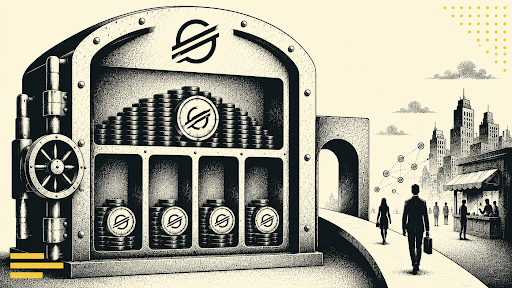
Stellar gains focus for fast payments, native USDC, Soroban smart contracts, and Sl8 Social wallet features built on XLM.
Stellar is returning to market discussion as traders revisit payment-focused blockchain networks. Scopuly said XLM is appearing again across professional trading desks.
The renewed focus is tied to Stellar’s long-running role in fast and low-cost transfers. Its network design also supports compliance-focused financial services and global payment rails.
Scopuly said Soroban smart contracts are expanding Stellar beyond payments. This gives the network a wider role across programmable finance and DeFi activity.
The discussion comes as stablecoin use, cross-border payments, and tokenized finance continue growing. XLM is now being compared with other payment-focused networks, including XRP, Solana, and Tron.
Payment Infrastructure Returns to Focus
Scopuly said Stellar is gaining attention because markets are again looking at real payment infrastructure. The wallet platform pointed to fast settlement, low fees, and global transfer use. These features have long been central to Stellar’s network design.
📈 Stellar $XLM Is Quietly Returning to Institutional Trading Desks
Not because of memes.
Not because of hype.
But because the market is starting to care about real payment infrastructure again. $XLM is re-entering conversations across derivatives and professional trading… pic.twitter.com/7zSEagF8FD— Scopuly – Stellar Wallet (@scopuly) July 26, 2026
The post also said XLM is entering conversations across derivatives and professional trading markets. That does not confirm a price move by itself. However, it shows that traders are watching Stellar’s role beyond short-term speculation.
Stellar was built around moving real-world value across borders. This gives it a different market position from networks driven mainly by trading cycles. Its payment focus remains important as institutions study blockchain-based settlement.
Soroban and USDC Expand Stellar Use
Soroban smart contracts are adding another layer to Stellar’s ecosystem. The upgrade allows developers to build programmable finance tools on the network. This moves Stellar beyond basic payments and asset transfers.
Scopuly also pointed to native USDC on Stellar as an important feature for institutions. USDC can support regulated-friendly money movement and stablecoin settlement. This may help firms seeking faster transfers without large fees.
The combination of USDC, Soroban, and low-cost settlement gives Stellar broader use cases. It can support cross-border payments, stablecoin activity, and DeFi products. Still, adoption depends on real demand from users and financial firms.
Read also: Stellar Leads Developer Growth As XLM Ecosystem Surges To 4,400 Builders
Sl8 Social Shows Wallet-Based App Model
Bu11runner said Sl8 Social has built wallet access directly into its app. The project runs on Stellar, with XLM supporting fast and low-fee transactions. This removes the need for users to connect a separate external wallet.
Most Web3 projects still treat the wallet like something you attach later.
Sl8 Social is one that’s doing it differently, they built the wallet straight into the app from the beginning.And it’s running on Stellar so $XLM takes care of the fast, low fee transactions underneath.… pic.twitter.com/YwVIiYRNDR
— Bu11runner (@thebu11runner) July 26, 2026
The app model includes tokenized engagement, staking, liquidity options, and peer-to-peer transfers. It also includes tips, RWA tokenization tools, and GameFi activity through Stardust mining. These features show how Stellar can support consumer-facing apps.
Built-in wallets may reduce friction for users trying new Web3 services. They can make blockchain features feel closer to regular app activity. Market watchers may now track whether Stellar apps increase usage, liquidity, and payment volume.



Leave a Reply
You must be logged in to post a comment.